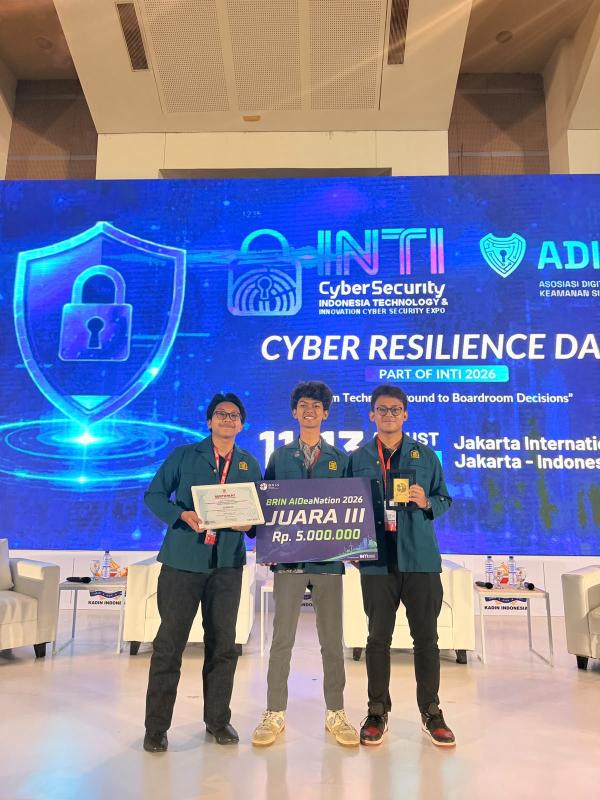
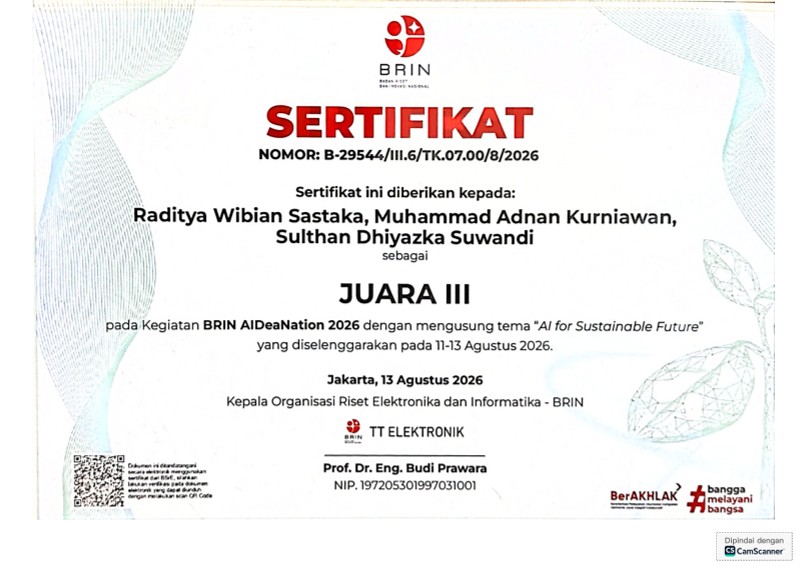
3rd Place, BRIN AIDeaNation 2026
National AI competition by BRIN. Our entry HujanNet estimates rainfall from microwave link signals for flood early warning.
 Award
Problem
The late-2025 floods in Aceh, North Sumatra and West Sumatra killed over a thousand people. Forecasts said heavy rain was coming; what was missing was measurement of where it actually fell. Indonesia runs 44 of the 75 weather radars it needs, and about one rain gauge per 1,900 km², far below the WMO guide of 100–250 km² for tropical mountains.
Idea
Cellular backhaul microwave links (7–40 GHz, 1–10 km long) lose signal when rain falls along their path. The ITU-R P.838 power law turns that attenuation into a path-averaged rain rate, so the network already installed across the country can act as a dense rain gauge. It needs a data-access agreement and received-power logs, not a single new sensor.
Where AI fits
Dust, temperature, dew and ageing hardware also weaken the signal, so wet/dry classification is staged from Random Forest to 1D-CNN to LSTM, cross-checked against neighbouring links. Turning many straight-line measurements into a 2D rain map is an ill-posed inverse problem, solved with a learned prior. The research core is adapting temperate-climate models to tropical convective rain and recalibrating k and α for Indonesia.
Operator dashboard
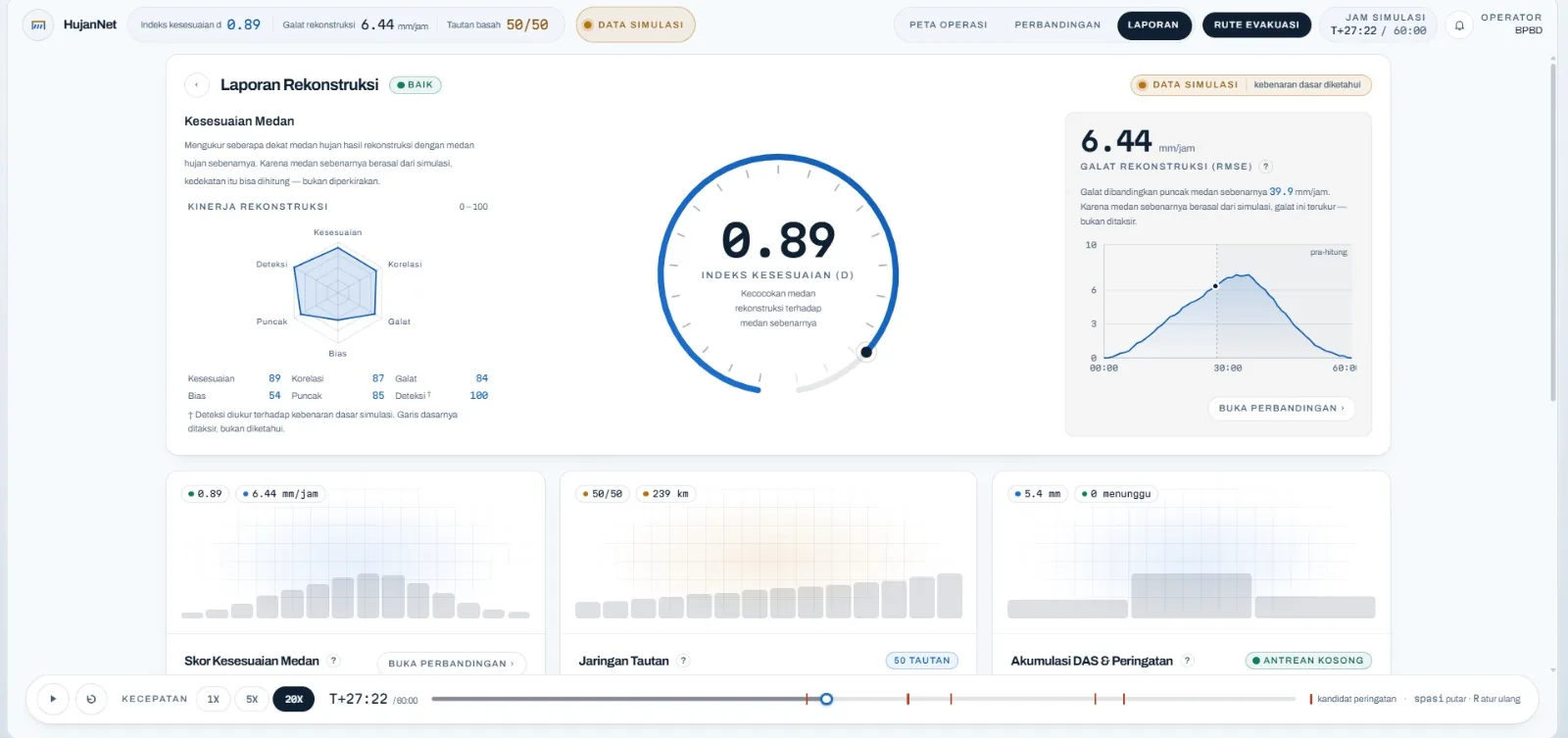
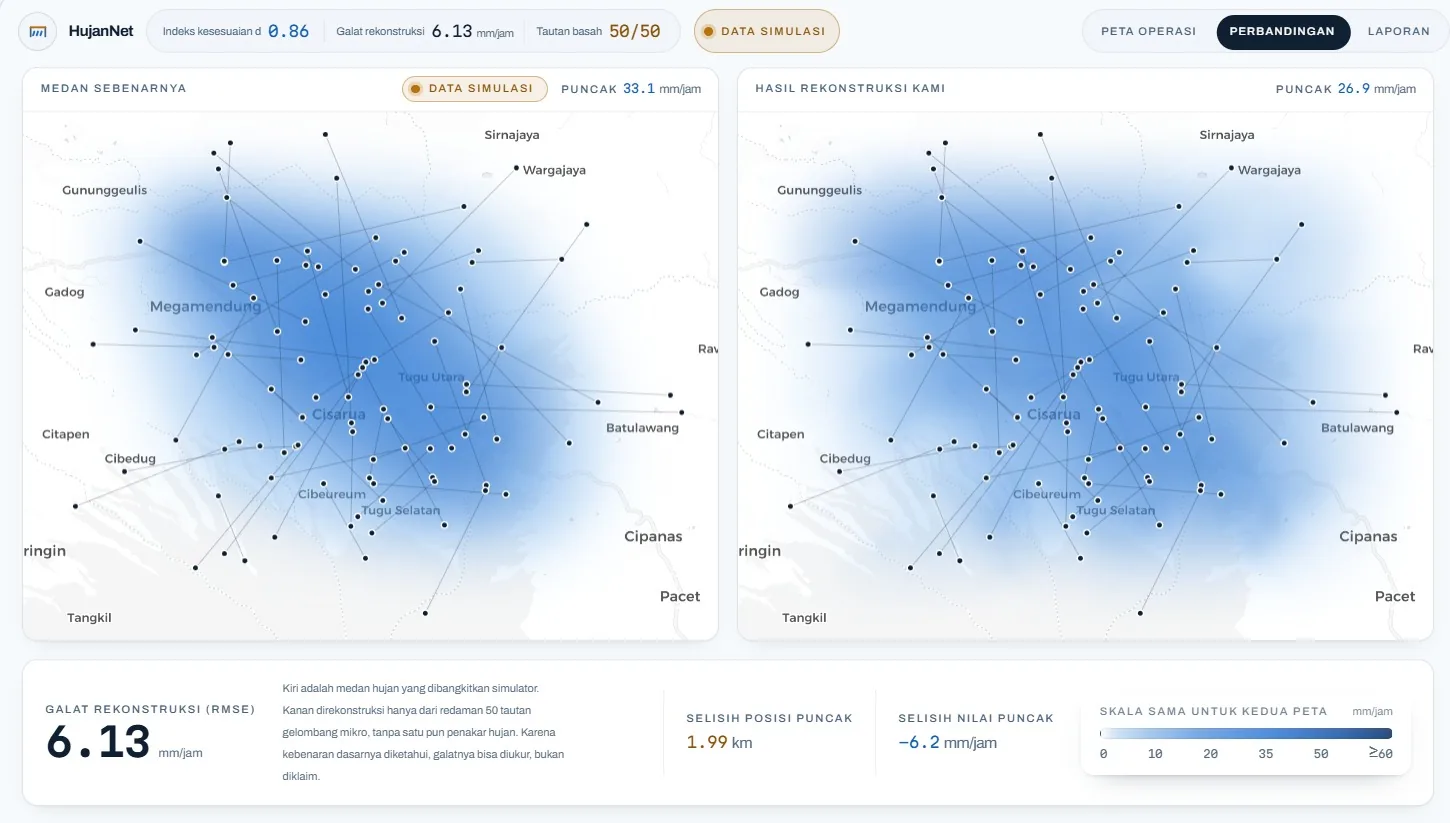
The Next.js and MapLibre dashboard reconstructs the rain field from simulated link attenuation. Because the simulated truth is known, it reports reconstruction error side by side, and accumulates rainfall per river catchment against alert thresholds. The system never broadcasts a warning itself: a BPBD operator must confirm each alert, since official meteorological warnings are BMKG's authority.
My role
Technical lead and proposal author: the technical proposal, the work timeline and a first-year budget aligned to SBM TA 2026. I defined the detection limit of sub-6 GHz signals and the device aggregation model needed to recover a usable rainfall signal from noise. In the research plan I own instrumentation and validation, including estimating tropical k and α and calibrating against BMKG rain gauges.
Outcome
3rd Place at BRIN AIDeaNation 2026 (theme "AI for Sustainable Future"), held in Jakarta on 11–13 August 2026, as Team AmanBey from ITB. The proposal lays out five validation layers, from synthetic tests with known truth to a pilot catchment, and states its limits openly: it is not a weather forecast and it is weak on light rain.